Yuriko Hayashi
I Survived by Miracles
3. August 6
In the early morning on August 6, a yellow alert was issued, quickly followed by a red alert. We hurriedly evacuated to an air-raid shelter, but the alert was quickly cleared and we returned home. After 8 a.m., I was supposed to be heading for school, but I was waiting for my mother to finish sewing on the buttons of the clothes she had sewn for me the day before. My father was supposed to be at work, but he was smoking at the entrance, saying, “I’m not feeling well.” Even though my younger brother normally would be playing outside, for some reason, he was inside the house. So, miraculously, that morning, all of our family were inside the house. If the A-bomb had been dropped a few minutes later, we would have been killed or seriously burned outside. I have never heard that any entire family, living 1.6 km from the hypocenter, survived the A-bomb.
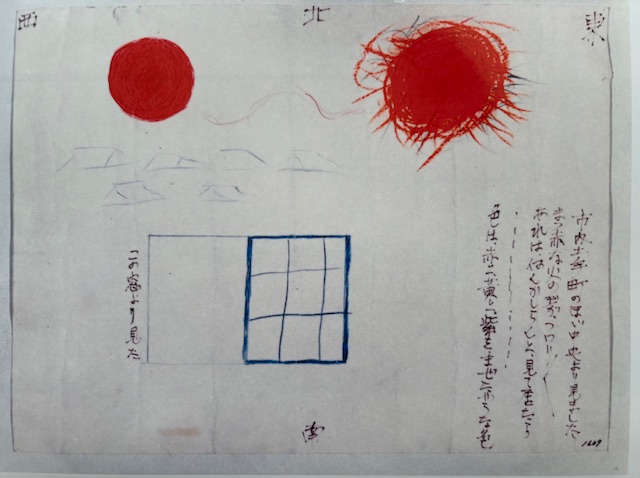
There were oleander trees in front of the entrance to the house, and the gate was beyond it. At 8:15 a.m., outside the gate, suddenly I saw an orange light flash I had never seen before. My mother was in the room with the windows on the west side facing the city, and she said that she saw two suns. After a while, we heard a booming sound that resonated in our stomachs. In Hiroshima, we call the A-bombing Pika-Don . Pika stands for a flash and Don stands for a booming sound.
Without knowing what had happened, I found myself lying under the kimono sash chest by the edge of the entrance. It was pitch dark all around. I didn’t feel any pain or difficulty in breathing. I was just trembling with fear. I shouted in a panic, “Help me!” and then I heard my mother’s voice from somewhere, “I’m here!” My two-year-old younger brother, who couldn’t still speak properly, shouted, “Takuteke. Takuteke” meaning ‘Help! Help!’ in baby talk. I still vividly remember his voice. Hearing our voices, my father, who could move, managed to pull us out of the debris, removing fallen pillars and furniture scattered around. My brother’s face and head were covered in blood, like he had suffered a serious injury.
Somehow, we all got out of the house. Okamoto, and Kobubaba also were blown around the house, but were able to get out on their own. Giving piggyback rides or holding my younger brother, my father decided to evacuate together to the air-raid shelter. My mother, blown through two glass doors, couldn’t move easily with shards of glass stuck all over her body. Our large and splendid house had completely collapsed.
Outside, we heard indescribable cries for help coming from all directions. On the way to the air-raid shelter, instead of heading straight for the shelter, my father rescued two or three people. Walking a little further, we found the child of our acquaintance crying out hoarsely on the broken roof, “Help my mother!” My father and Okamoto tried to pull her out but couldn’t help, as flames were approaching them. Somehow, our family made it to the air-raid shelter. There, my mother wiped the blood off my younger brother’s face and saw that only a small injury was on his forehead.
When we looked outside from inside the shelter, we saw a young man carried on a wooden door pass by us, whose whole body from face to the tips of his foot was covered with blood. He was Mr. Hatanaka, who had always been very kind to me.
Then, we decided to go to another air-raid shelter on Hijiyama Hill. On the way, my father sometimes stopped to pour water to extinguish fires on the houses and trees we passed. While going up the hill, my heart broke to see the bodies lying around. Some of them were people I knew. I couldn’t walk forward without stepping on their bodies. I can’t forget the feeling on my bare feet when I stepped on the bodies. People passed us, staggering with their skin sagging from their fingertips. Since lowering hands was painful, naturally they walked holding their hands out in front of their chest like ghosts.
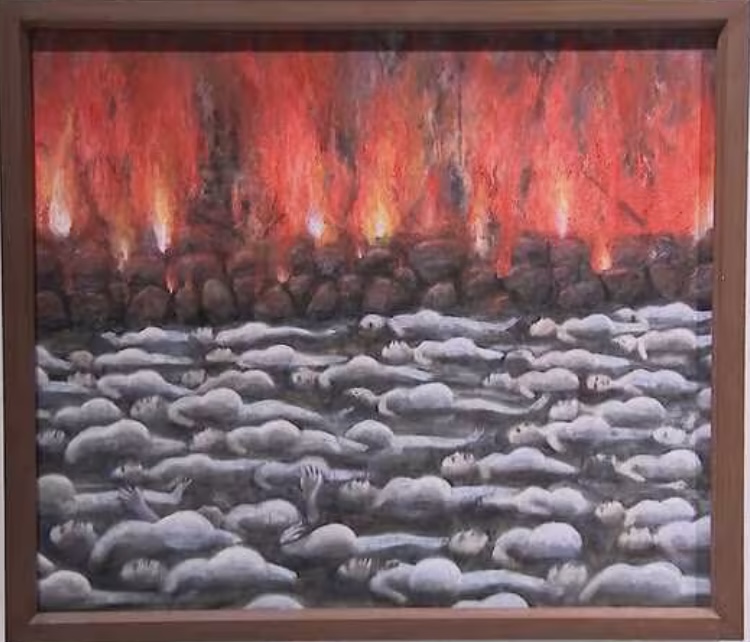
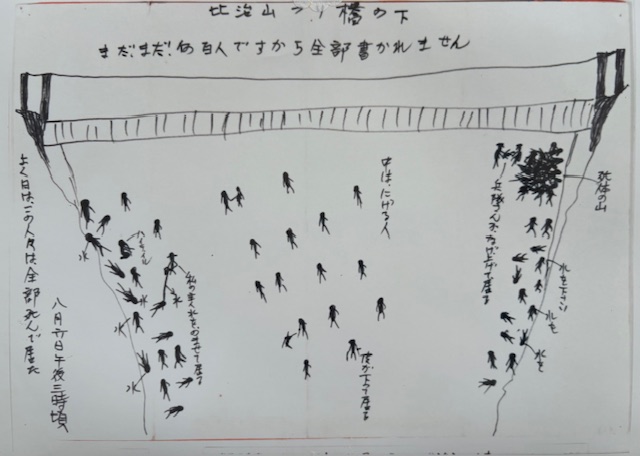
Though we reached the air-raid shelter on the hillside, my father went down again toward the burning city and returned with a bucket of water and a ladle. He dripped water into the mouths of victims, who were desperately pleading “Give me water! Give me water!” Even though an officer said to him, “If you give them water, they will die,” he gave them water, saying, “They are going to die whether they will drink it or not.” The people, given a sip of water, moved their lips as if they were saying, “Thank you,” and then died. Many people, who had severe burns all over their bodies, went into the Kyobashi River and died there. The Kyobashi River flowing by Hijiyama Hill was filled with bodies.
Inside the air-raid shelter, it was pitch dark. Some people were already dead and many others were seriously injured. The shelter was filled with a sickening smell. When a U.S. military aircraft flew over us, we were afraid of another bomb and went deeper into the shelter. Later, it turned out that the plane was a reconnaissance plane sent to confirm the power of the A-bomb. I wonder what the U.S. soldiers in the plane thought about the tragic scene below them, even if we were their enemy.
Since it was pointless to stay in the shelter any longer, we decided to go down the hill. At the end of a suspension bridge on Hijiyama Hill, there were many mountains mounds of bodies on the way to the top of the hill. We descended the hill to Danbara, on the opposite side we climbed up. Most of the houses there escaped fire. Mitsuboshi Confectionary was in Danbara, and we knew that they had hardtack there, so Okamoto collected hardtack scattered around the factory and brought it to us.
My mother had glass shards stuck all over her body, especially from her right shoulder to her back, and her wounds cracked like a pomegranate with red flesh visible there. The blood was sticky on her clothes, but even in that condition, she just walked, staggering behind us without complaining that it hurt. My younger brother was carried by my father. When we got to the East Drill Grounds at the north side of Hiroshima Station, we saw burning red corrugated tin plates, large boards, wooden pieces and many other things flying in the sky, blown up by the wind caused by fire. After those things fell, the ground was too hot to walk on. There were bodies lying on the ground. Almost naked, I kept moving forward to stay away from the fire, stepping barefoot on hot and burning debris, broken glass and even dead bodies.
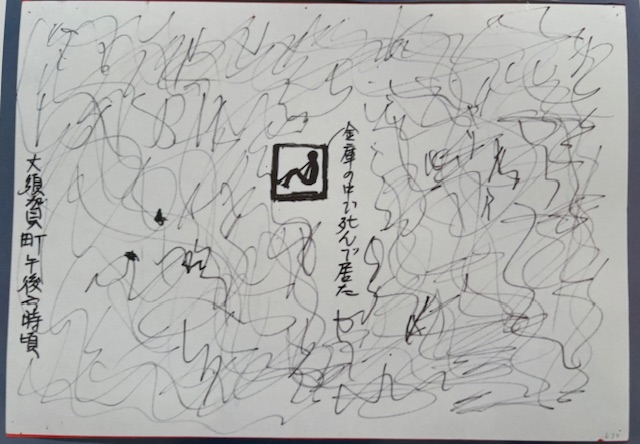
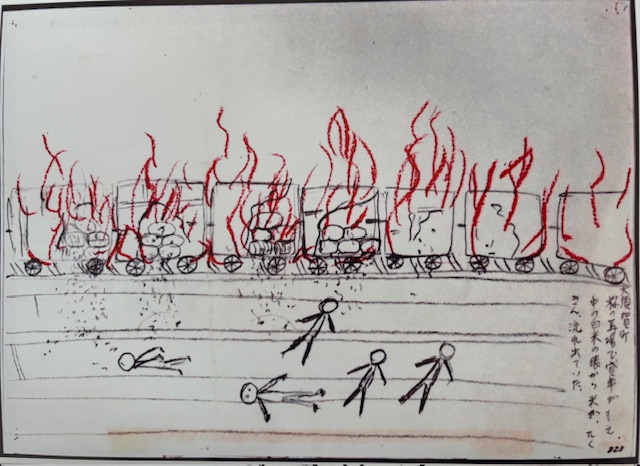
We passed in front of Nigitsu Shrine and came to Osuga-cho. Freight cars with rice had overturned there, and rice was spilling out. My father took some of it. Until then, it seemed like the flames were chasing us, but by the time we reached Ushita, they finally stopped just before reaching us. It was already getting dark. When I looked up at the mountains to the east, the mountain top was dyed with red due to the fires in the city, and it was also dimly lit and hazy around Ushita.
Adding to the four of our family, Okamoto, and Kobubaba, my uncle, my aunt and my two cousin sisters, totally ten people lay our exhausted bodies down on the grass of Futamata River flowing through Ushita. I wondered how many kilometers we I had walked barefoot, stepping over glass shards, pieces of wood and nails, even dead bodies. I’ll never forget that feeling. We kept walking through hot places that they couldn’t be called roads.
We lived on that riverbank for two months. Sometimes, my father brought us food from somewhere, like eggplants or cucumbers someone gave him, insects, or fish he caught in the nearby stream. We drank the river water and washed our bodies in the stream while still wearing our underwear.
About two months later, at a vacant lot in the corner of the city land near the riverbank, my father and Okamoto tied boards with rope to make a floor and built something like a crude shack with burned corrugated tin plates as walls. I couldn’t even sit up and lay down all the time. It is often said that many A-bomb survivors suffered from so extreme fatigue that they couldn’t sit up and were bedridden soon after the A-bombing. At first, people didn’t know the reason of the illness. The survivors couldn’t get any work done and were laying around at home. The illness was called “Burabura-Byo” meaning a lingering illness. Later, it was thought to be caused by a decline in organ function due to radiation. Probably, I was suffered from the same disease.