Yuriko Hayashi
I Survived by Miracles
4. My Family After the War
Pieces of glass remained embedded in my mother’s skin, and the wounds began to fester. Flies gathered around them. They became infested with maggots and gave off such a terrible smell that even today, my brother says he can never forget it. A few days later, after hearing that a doctor was treating people at the schoolyard of Ushita Elementary School, my father took her there. There was a long line, and although they waited for hours, the doctor only applied mercurochrome and did not remove any of the glass pieces. At that time, mercurochrome was virtually the only medicine available and was used for all kinds of injuries. The wounds on my mother’s right shoulder eventually developed into keloid scars that never healed.
As a child, my father looked fine to me. Considering the radiation he was exposed to, he may have suffered from illness, but he always carried on bravely and worked hard for our family. He was the kind of person who shared what little food we had with people in need, even when our own family was living hand to mouth. When the atomic bomb was dropped, he was 62 years old. He died at the age of 84. My brother was also exposed to radiation, but he suffered no acute effects.
However, I suffered severe acute effects from the atomic bomb. I vomited every day, had a high fever, and lost my hair. After we moved into the shack my father had built, I became so ill that I could not even sit up. Although I ate nothing, I kept vomiting—sometimes blood. My mother gathered wild plants along the riverbank that she believed would help my condition and made a medicinal decoction from them. It took me a full year to recover. I survived thanks to my parents’ love.
My elder brother was a pilot of the kamikaze attack units. Just before his plane was scheduled to depart on a suicide mission, the war ended. He was demobilized and returned home at the end of 1945. Because my father had left a sign indicating our whereabouts at the ruins of our house in Dote-cho, my brother was able to find us in Ushita. When he had enlisted, he had a firm resolve to give his life for his country; however, because the war ended, he was unable to fulfill that aim. He returned home deeply troubled and suffered from mental illness. Fearing that neighbors might label him unpatriotic, my mother did not allow him to go outside. For two years, he was incapacitated by his mental condition, but gradually, he recovered. As he was methodical and intelligent, an acquaintance introduced him to a job at a bank where he was able to work.
At that time, no one knew what radiation was. People believed that “poisonous gas” remained in the city because those who had not been directly exposed to the bomb began to suffer from atomic bomb–related illnesses and died. For this reason, my father gave up returning to Dote-cho and decided to remain in Ushita. He was granted a plot of land on higher ground in Ushita, which the city had prepared for hibakusha. He built a fairly large house there. Although I did not know the details at the time because I was still young, four or five years later, someone cheated him and he lost both the house and the land. He had no choice but to build another house on the site where our shack had stood. My father was kind-natured and gave away whatever we had to people in need. He may have been taken advantage of amid the confusion and hardship of the postwar period.
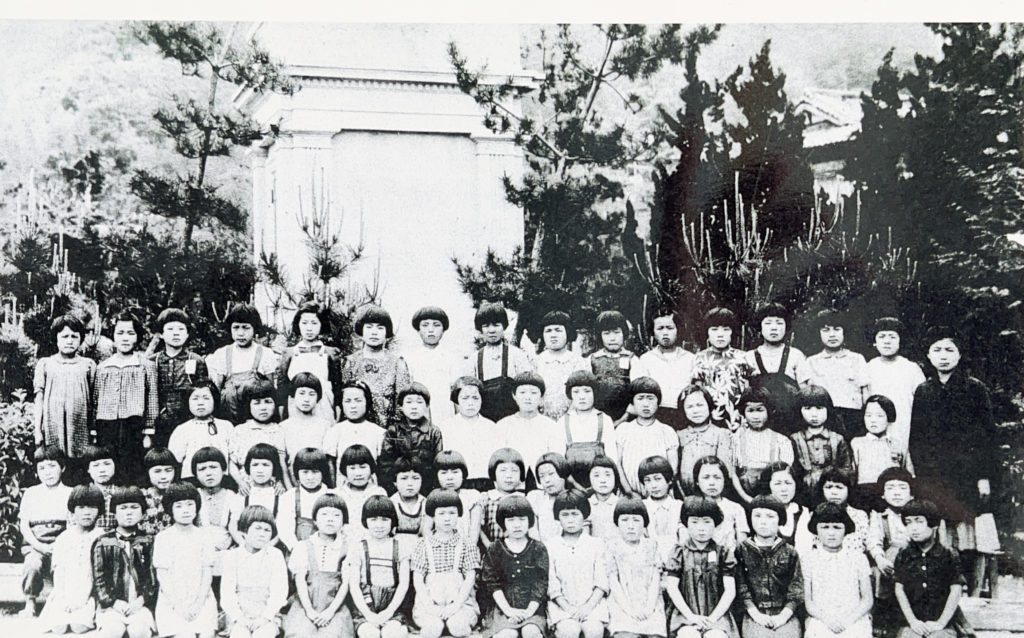
I remained bedridden and did not attend school during the second and third terms of third grade. The following April, I recovered somewhat and began attending Ushita Elementary School. However, most of the children had been evacuated and had not been in Hiroshima at the time of the bombing, so there were almost no students there who had been directly exposed to radiation. I was bullied not only by other children but also by teachers. They said things such as, “Your illness is infectious,” “I heard that poisonous gas comes out through the pores of hibakusha,” and “Poisonous gas comes out even when you breathe.” They also mocked me, saying, “You don’t have any money, so you can’t go on the school excursion, can you?” Because I had not fully recovered, I attended school only sporadically until I graduated from elementary school. In 1949, I entered Noborimachi Junior High School. By that time, my health had greatly improved.